Why Abzena?
Trust our focused approach.

Trust our focused approach.

Meet our experienced team.

Partnering for success.

Quality is culture.

20+ years of biologics expertise.

State-of-the-art, global facilities.

Earning customer trust.

Recognition of our success.

Meet our scientific experts.

High Affinity, Desired Biological Activity, Hybridoma Sequencing...

Protein Engineering, Antibody Humanization, Deimmunization...

Early De-Risking & Developability, Specificity, Functionality, Safety...

Analytical Method Development, Fc Binding & Functional Assays...

EpiScreen® 2.0, Immunogenicity Risk Assessments, T Cell Assay...

Fully Portable, No Abzena Exit Fees, No Royalties, Single Milestone Payment at IND*

Monoclonal Antibodies, Proteins, Antibody-Drug Conjugates...

Process Transfer, Characterization & Validation, CLD to Patient...

Clinical Thru Commercial, Tech Transfer, Scale Up, Quality...

Payload Design & Synthesis, Analytical Methods, HPAPI...

ADC, AOC, RDC Design & Discovery...

ADC, AOC, RDC Development, De-Risking & Developability...

Complex & Analytical Chemistry, Polymer Conjugate Formulation...
Analytical Method Development, Bioconjugate Characterization...
EpiScreen® 2.0, Bioconjugate & ADC Immunogenicity Analysis...
ADC Formulation, Customized, Stable Liquid & Lyophilized...
Process Transfer, Characterization & Validation, Stability...
ADC Manufacturing, Clinical Thru Commercial, Tech Transfer...

Discover AbZelectPRO™ + New CHOSOURCE™ GS Knockout

Discover EpiScreen® 2.0

Starting smart, finishing fast.

Discover LabZient™

Discover Composite Human Antibody™

Discover ThioBridge™

Discover Composite Proteins™

Unique insights into how we partner with our customers.

Offering an overview of our services and expertise.

Published scientific articles reviewed by our peers.

Looking for inspiration? Our whitepapers can help.

Watch our experts share their knowledge on-demand.

Access to our latest scientific featured articles.
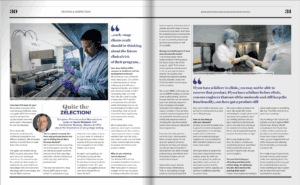
European Pharmaceutical Manufacturer featured an interview with our SVP of Commercial Strategy, Gavin Murdoch in their November-December Issue focused on the importance of early stage testing. The interview took place in October at CPHI Frankfurt.
How has CPHI been for you?
We’ve been very lucky at this show because ADCs have been sort of a hot topic for a couple of years now. And we’ve been in that space for over two decades.
We’ve dealt with thousands and thousands of different conjugations and different problems with antibodies and how to modify them to make them work correctly.
And again, we’ve been doing AOCs for years and years. They were very rare, but people came to us. So, now we’ve got the experience that people are looking for. So, about half of our early-stage work and a lot of our late-stage work is now oligos, and not just ADCs anymore.
You’re a global company. Are there any particular places that you’re finding there’s like a lot more demand?
We’re predominantly supporting US and European countries. We are seeing European countries trying to move their late-stage production into the US because of the ongoing tariff and the potential risks.
The way that works for a drug from a tariff’s point of view, is that it’s counted as a drug where its final creation is done, so, if you make an antibody in Europe and you make a linker- payload in Europe, but you do the conjugation in the United States, you’re good.
So again, we’re getting a lot of inquiries by people that would’ve finished the drug in Europe that are trying to do the conjugation in the US – you can’t ship a conjugated product over here and just fill it to avoid the tariff.
How does AbZelectPRO™ compare to traditional cell line development methods?
We’ve had our own cell line for many, many years. Our cell line is extremely good at making challenging and difficult-to-express antibodies, and while it was robust and stable, it didn’t necessarily make very high titres. We did a deal a couple of years ago with ProteoNic to incorporate their 2G UNic® vector technology into our cell line development platform and in doing that, what we found it increased titres significantly, and increased the stability of the clones.
We’re seeing after clone selection, six to eight, sometimes up to 10 grams per litre, which is, I would say, at or above industry standard right now. We took a very robust, useful tool and made it more commercially interesting for people with still the same quality or better.
Why are you choosing now to improve?
Our AbZelectPRO™ cell line development platform has been around about two years now. After many years of using our program which was very good at making antibodies that were hard to express, there was a bit of debate about the state-of-the-art in terms of productivity, and I think the marketing team convinced the technical team that they needed to look at something that would get them productivity as well as versatility.
Moving on to EpiScreen® 2.0, how does this benefit clients?
A lot of early-stage clients really should be thinking about the future clinical risk of their program right? That’s where immunogenicity testing comes in. So, as you may be aware, Abzena has actually been doing immunogenicity testing for over 20 years. It was one of the foundation technologies of the company.
We can do PBMC cell assays, we can do MAPPs testing, we can do some in silico testing, we have enough data that we can actually look at an antibody sequence from somebody and predict what part of the molecule may cause a problem. Then we have a protein engineering group that can potentially take that out and modify that sequence without changing the way the antibody works and in doing so, reduce the immunogenic risk.
If you don’t do that, you find out in the clinic, when product failure is much worse. You’ve spent an awful lot of money and gone nowhere, but instead we can perhaps fix it earlier in development. So, either through engineering or sometimes even through formulation, we can resolve those issues.
Some of the larger pharma, they’re doing it themselves. They’re now getting enough products coming through that they can’t handle it anymore, and so they’re coming back to us and we’re filling the gap.
How do you keep up with your demand?
At some point we’ll probably have to grow the number of people in the organisation. In Cambridge, maybe a third of the team there are analytical; biologics analytics are very complicated. ADC and AOC analytics is even more complicated.
We’ve got teams of people that have been cross-trained across multiple areas. So, while we have core groups for particular specialities, when a chunk of new work comes in and it’s beyond their normal capacity, we can flex in additional expertise to support them.
We used to block schedule the work. We would offer block scheduling for people where we’d say, okay, we’re going to open up a testing slot here and you get a reduction in fee because we’re now able to do one setup for samples from many clients. We’ve sort of stopped doing that because the demand is so high.
We’re now booking all the time. So, there’s a continuous scheduling going on, essentially. It has lowered the cost and you don’t have to wait. You just come straight in.
You said that if they put off testing and then at the clinical stage, it’s obviously too late. How much is this pushing them back?
I mean, immunogenicity testing is about eight weeks or something like that. The FDA looks for it as part of your package.
You’re taking a risk if you’re not actually running it against PBMC from human donors. We tell everybody to do it. If you have a failure in the clinic, you may not be able to recover that product. If you have a failure before the clinic, you can engineer that out of the molecule and still keep the functionality; you’ve got a product still.
It’s a really cheap investment to be quite honest, and it doesn’t really slow anything down. You keep on going and then you get the result long before you’ve made anything too big or gotten too far down the line in your development program.