


Why Abzena?
Trust our integrated approach.

Trust our integrated approach.

Meet our experienced team.

Partnering for success.

Quality is culture.

20+ years of biologics expertise.

State-of-the-art, global facilities.

Earning customer trust.

Recognition of our success.

Meet our scientific experts.

High Affinity, Desired Biological Activity, Hybridoma Sequencing...

Antibody Engineering, Fc Engineering, Antibody Expression, Humanization, Deimmunization...

Early De-Risking & Developability, Antibody Development...

Analytical Method Development, Fc Binding & Functional Assays...

EpiScreen® 2.0, Immunogenicity Risk Assessments, T Cell Assay...

GMP-Ready, Accelerates Timelines, Reduces Risks, & Ensures Scalability, Stable Pools in 3 Weeks

Monoclonal Antibodies, Proteins, Antibody-Drug Conjugates...

Upstream & Downstream, Process Transfer, Scale Up, Characterization & Validation, CLD > Patient...

Clinical Thru Commercial, Tech Transfer, Scale Up, Quality...

Payload Design & Synthesis, Analytical Methods, HPAPI...

ADC, AOC, RDC Design & Discovery...

ADC, AOC, RDC Development, De-Risking & Developability...

Complex & Analytical Chemistry, Polymer Conjugate Formulation...
Analytical Method Development, Bioconjugate Characterization...

Seamless Transfer, Quality Commitment, Regulatory Compliance, ADC Tech Transfer
ADC Formulation, Customized, Stable Liquid & Lyophilized...
Process Transfer, Scale Up, Characterization & Validation, Stability...
ADC Manufacturing, Clinical Thru Commercial, Tech Transfer, HPAPI Handling...

Discover AbZelectPRO™ - seamlessly go from Stable Pools to IND

Discover EpiScreen® 2.0

Starting smart, finishing fast.

Discover LabZient™

Discover Composite Human Antibody™

Discover ThioBridge®

Discover Composite Proteins™

Unique insights into how we partner with our customers.

Offering an overview of our services and expertise.

Published scientific articles reviewed by our peers.

Looking for inspiration? Our whitepapers can help.

Watch our experts share their knowledge on-demand.

Access to our latest scientific featured articles.

We design and engineer bispecific antibodies, multispecific antibodies, and T cell engagers (TCEs) for immunotherapy, combining deep scientific expertise with integrated development capabilities to accelerate candidate selection, reduce development risk, and unlock therapeutic potential beyond traditional monoclonal antibodies.
Designing and producing bispecific antibodies can be complex, but Abzena has extensive experience in creating bispecific and multispecific formats, as well as antibody-drug conjugates (ADCs).
We recognize that every program has unique requirements. Our proven antibody design and production strategies allow rapid screening of key features such as avidity, spacing, stoichiometry, and arm formatting. This ensures efficient bispecific antibody design and development from early discovery through clinical readiness.

There are several critical factors to consider when starting a bispecific antibody development project. Early design choices have a major impact on stability, manufacturability, and therapeutic function.
Successful bispecific antibody design should:
Rapid screening of multiple bispecific and multispecific antibody designs, even with subtle structural differences, is essential to select the most viable format for development.
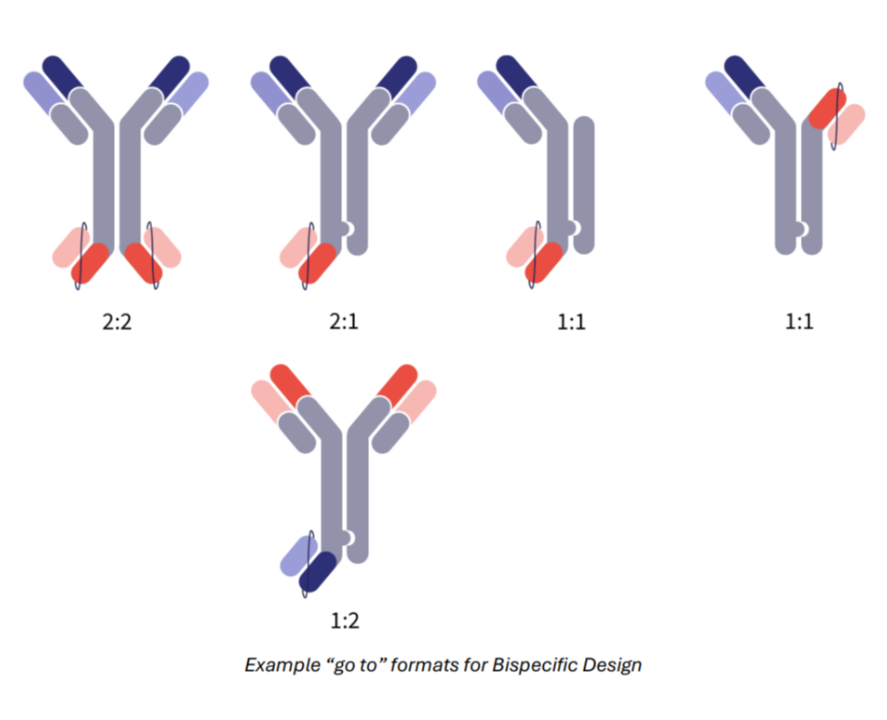
Bispecific antibodies integrate multiple binding specificities into a single construct. Over time, many bispecific formats have emerged, each with unique advantages and development challenges, including freedom to operate.
If your program already uses a preferred bispecific antibody design, Abzena can support optimization and manufacturability. Where an optimal format is still under evaluation, our team offers access to a focused panel of IP-free, proven bispecific antibody formats to explore functionality and performance efficiently.
One of the main challenges in bispecific antibody development is avoiding chain mispairing during expression. A common strategy to overcome this is the knob-into-hole (KiH) approach. This technique involves co-expressing two antibody heavy chains with targeted mutations that form a “knob” on one chain and a complementary “hole” on the other, promoting correct heterodimer formation.
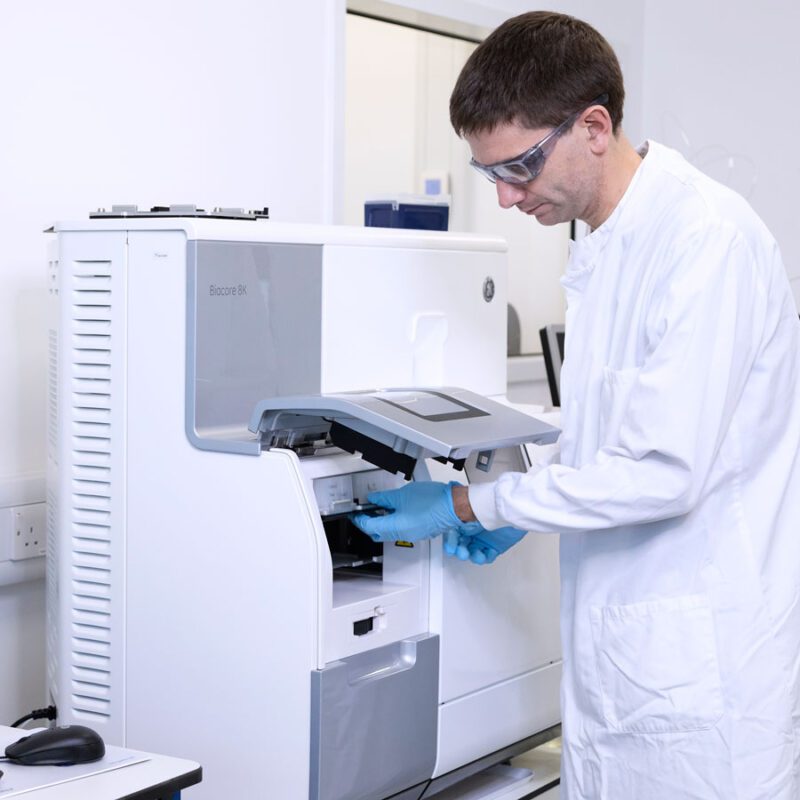
Abzena has extensive experience in bispecific antibody design, expression, and purification. Our teams work across multiple bispecific formats, including knob-into-hole and other advanced heterodimerization technologies, to ensure high purity and functional integrity.
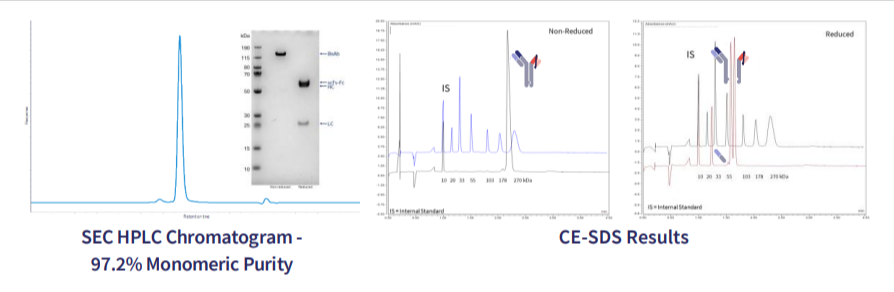
Because of the structural complexity of bispecific antibodies, detailed characterization and analysis are essential. Traditional analytical tools such as SDS-PAGE and SEC are often insufficient. Advanced methods like intact mass spectrometry and SEC-MALS are required to confirm correct bispecific antibody formation and purity.
Further assessments, including thermal stability profiling, provide valuable insights into molecular stability and developability. Abzena’s analytical scientists evaluate each bispecific or multispecific antibody using the most appropriate techniques to ensure reliability and reproducibility.
Characterization alone is not enough. Functional validation is critical. Working with Abzena’s bioassay team, tailored assays can be developed to confirm biological activity and support lead candidate selection.

Bispecific T cell engagers (TCEs) represent a powerful class of antibody-based immunotherapies that redirect T cells to selectively recognize and destroy cancer cells. By simultaneously binding a tumor-associated antigen and a T cell receptor, typically CD3, TCEs create a synthetic immune synapse that drives targeted cell killing while offering the scalability advantages of an antibody-based therapeutic.
The promise of T cell engagers comes with significant development challenges. Molecular architecture, binding affinity, valency, geometry, Fc design, chain pairing, stability, manufacturability, and safety profiles can all influence therapeutic performance. Early design decisions are therefore critical to identifying candidates that combine strong biological activity with robust developability characteristics.
Abzena’s T Cell Engager Expertise
Abzena applies a platform-based approach to T cell engager development, leveraging extensive experience in antibody engineering, expression, purification, characterization, and functional testing. Our scientists understand that successful T cell engager programs require more than demonstrating biological activity.
Candidates must also exhibit the stability, manufacturability, and developability needed to support progression through preclinical and clinical development.
By rapidly generating and evaluating multiple bispecific formats, valencies, geometries, and molecular architectures, we can assess how subtle design variations influence target engagement, T cell recruitment, potency, safety profile, and overall developability. This systematic approach enables informed candidate selection while reducing the risks associated with complex bispecific molecules.
Our integrated capabilities support:
By combining deep expertise in bispecific antibody developability with integrated discovery and development capabilities, Abzena helps partners efficiently identify the most functional and developable T cell engager candidates, enabling a faster path toward clinical success.
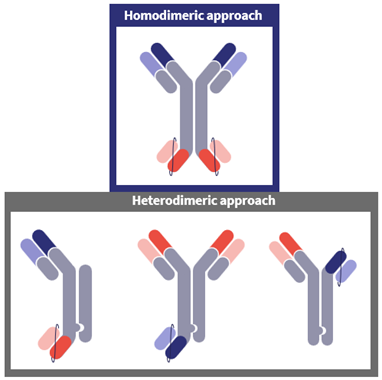
Abzena can work with you to develop the right bispecific or multispecific antibody for your application. By leveraging unparalleled expertise in antibody production, purification, analytics and functional bioassays, we can rapidly identify and advance the most promising bispecific candidates.
Whether you are at an early stage or further down the developmental path, we offer services and the necessary expertise that help to get you to the next destination.
Bispecific antibodies are engineered proteins that bind to two different antigens or epitopes at once. This dual binding improves targeting accuracy and therapeutic potential compared to traditional monoclonal antibodies.
Monoclonal antibodies target a single antigen. Bispecific antibodies engage two targets, offering enhanced therapeutic control and improved cell-to-cell interactions. This key distinction explains the difference between monoclonal antibody vs bispecific function.
No. While both are antibody-based therapeutics, bispecific antibodies are engineered from monoclonal antibody components but have two specific binding sites instead of one.
Multispecific antibodies bind to more than two targets, offering complex therapeutic effects. These constructs extend beyond bispecific designs to support advanced immunotherapy strategies.
Abzena provides complete support for bispecific and multispecific antibody programs, from molecular design to analytical testing and manufacturing. Our integrated services ensure efficient development and regulatory readiness.

We enable you to bring life-changing medicines to patients in need faster.