Why Abzena?
Trust our focused approach.

Trust our focused approach.

Meet our experienced team.

Partnering for success.

Quality is culture.

20+ years of biologics expertise.

State-of-the-art, global facilities.

Earning customer trust.

Recognition of our success.

Meet our scientific experts.

High Affinity, Desired Biological Activity, Hybridoma Sequencing...

Antibody Design, Protein Engineering, Antibody Humanization, Deimmunization...

Early De-Risking & Developability, Specificity, Functionality, Safety...

Analytical Method Development, Fc Binding & Functional Assays...

EpiScreen® 2.0, Immunogenicity Risk Assessments, T Cell Assay...

Fully Portable, No Abzena Exit Fees, No Royalties, Single Milestone Payment at IND*

Monoclonal Antibodies, Proteins, Antibody-Drug Conjugates...

Upstream & Downstream, Process Transfer, Scale Up, Characterization & Validation, CLD > Patient...

Clinical Thru Commercial, Tech Transfer, Scale Up, Quality...

Payload Design & Synthesis, Analytical Methods, HPAPI...

ADC, AOC, RDC Design & Discovery...

ADC, AOC, RDC Development, De-Risking & Developability...

Complex & Analytical Chemistry, Polymer Conjugate Formulation...
Analytical Method Development, Bioconjugate Characterization...

Seamless Transfer, Quality Commitment, Regulatory Compliance, ADC Tech Transfer
ADC Formulation, Customized, Stable Liquid & Lyophilized...
Process Transfer, Scale Up, Characterization & Validation, Stability...
ADC Manufacturing, Clinical Thru Commercial, Tech Transfer...

Discover AbZelectPRO™ + New CHOSOURCE™ GS Knockout Cell Line Platforms

Discover EpiScreen® 2.0

Starting smart, finishing fast.

Discover LabZient™

Discover Composite Human Antibody™

Discover ThioBridge®

Discover Composite Proteins™

Unique insights into how we partner with our customers.

Offering an overview of our services and expertise.

Published scientific articles reviewed by our peers.

Looking for inspiration? Our whitepapers can help.

Watch our experts share their knowledge on-demand.

Access to our latest scientific featured articles.
Unlock Mechanistic Clarity for Your ADC Program
Traditional in vitro assays tell you if your ADC works. But in today’s competitive and increasingly regulated landscape, you need to know how — and that distinction can make or break a development program.
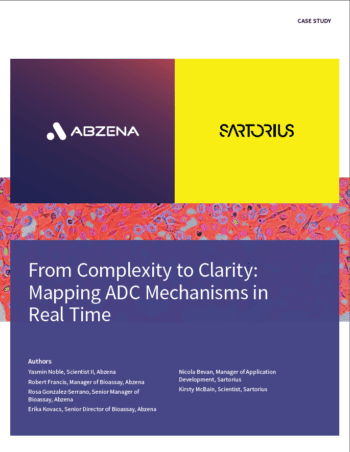
In this case study, Abzena scientists partnered with Sartorius to demonstrate how an integrated live-cell imaging approach, using the Incucyte® Live-Cell Analysis System, can resolve payload-driven killing, immune-mediated cytotoxicity, and bystander effects within a single, scalable experiment — no separate assays required.
Using Kadcyla and Enhertu as benchmarks, the team profiled two clinically validated ADCs against mixed Her2+ and Her2- tumor spheroids across multiple concentrations, effector-to-target ratios, and PBMC donors. The result? Rich, kinetic data that mirrors real clinical treatment selection patterns and surfaces mechanistic differences that conventional endpoints simply miss.
Download the case study to discover:
Whether you’re profiling a novel ADC or stress-testing your lead candidate, Abzena’s bioassay expertise can help you move from complexity to clarity — faster.