Why Abzena?
Trust our integrated approach.

Trust our integrated approach.

Meet our experienced team.

Partnering for success.

Quality is culture.

20+ years of biologics expertise.

State-of-the-art, global facilities.

Earning customer trust.

Recognition of our success.

Meet our scientific experts.

High Affinity, Desired Biological Activity, Hybridoma Sequencing...

Antibody Engineering, Fc Engineering, Antibody Expression, Humanization, Deimmunization...

Early De-Risking & Developability, Antibody Development...

Analytical Method Development, Fc Binding & Functional Assays...

EpiScreen® 2.0, Immunogenicity Risk Assessments, T Cell Assay...

GMP-Ready, Accelerates Timelines, Reduces Risks, & Ensures Scalability, Stable Pools in 3 Weeks

Monoclonal Antibodies, Proteins, Antibody-Drug Conjugates...

Upstream & Downstream, Process Transfer, Scale Up, Characterization & Validation, CLD > Patient...

Clinical Thru Commercial, Tech Transfer, Scale Up, Quality...

Payload Design & Synthesis, Analytical Methods, HPAPI...

ADC, AOC, RDC Design & Discovery...

ADC, AOC, RDC Development, De-Risking & Developability...

Complex & Analytical Chemistry, Polymer Conjugate Formulation...
Analytical Method Development, Bioconjugate Characterization...

Seamless Transfer, Quality Commitment, Regulatory Compliance, ADC Tech Transfer
ADC Formulation, Customized, Stable Liquid & Lyophilized...
Process Transfer, Scale Up, Characterization & Validation, Stability...
ADC Manufacturing, Clinical Thru Commercial, Tech Transfer, HPAPI Handling...

Discover AbZelectPRO™ - seamlessly go from Stable Pools to IND

Discover EpiScreen® 2.0

Starting smart, finishing fast.

Discover LabZient™

Discover Composite Human Antibody™

Discover ThioBridge®

Discover Composite Proteins™

Unique insights into how we partner with our customers.

Offering an overview of our services and expertise.

Published scientific articles reviewed by our peers.

Looking for inspiration? Our whitepapers can help.

Watch our experts share their knowledge on-demand.

Access to our latest scientific featured articles.
Author: Dr Rob Holgate, VP of Research & Innovation | Dr Gary Watts, Director of Formulation Development
In the first two parts of this 3-part series, our experts, Dr Rob Holgate & Dr Gary Watts, explored how early and mid-stage developability assessments underpin the rational design and selection of biologic drug candidates. However, as you get closer to lead candidate nomination, the purposes of assessments change. Rather than seeking to eliminate large numbers of unsuitable candidates as quickly as possible, the aim is now to provide a much more detailed deep dive into a smaller number of potential candidates to ensure they are fit for purpose.
This becomes increasingly important as molecules scale up as part of their CMC strategy and move toward the clinic, since new challenges emerge – ones that can only be addressed by rigorous later-stage developability evaluations.
In this final article, we detail how these assessments enable lead candidate selection, de-risk clinical progression, support regulatory submissions, and ultimately help drive late-phase commercial success.
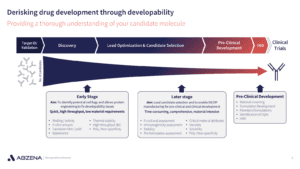
As described in Part 2, the best molecule is not always just the one with the best in vitro potency; rather, it is the candidate with the optimum combination of biological activity, safety, and manufacturability.
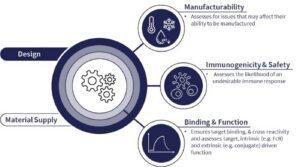
To achieve this, a holistic view is required, focusing on three primary aspects:
As discussed in Part 2 of this blog series, early-stage studies are often performed using material from transient expression systems because they are often faster and more cost-effective. However, these systems are typically used as surrogates for the final manufacturing cell line. This distinction becomes especially important for complex molecules, where transitioning between different hosts can reveal unexpected issues. Moving into the final manufacturing system as early as possible therefore improves translatability into CMC and helps derisk the overall program.
Adopting stable pools can offer several important advantages:
For this reason, it is becoming increasingly common to introduce stable pools based on the manufacturing cell line earlier in development – for example, by taking multiple clones into stable pools, such as with our AbZelectPRO™ CHO-K1 cell line.
Whereas early-stage assessments focus on “simple” biochemical or cell-based assays, assays and assessments at later stages tend to be more in-depth. However, as you progress to more relevant biological models such as 3D models or organoids, the complexity, and variability (and cost) increases. While the functional assays are likely to be very target and MoA-specific, there are a number of common assessments that should be considered at this stage, especially from a safety perspective.
Examples of these types of assays include:
When it comes to Immunogenicity, even well-engineered and stable molecules can trigger immune responses in humans. Later-stage immunogenicity assessments go beyond the in silico predictions used at earlier stages of R&D and focus on using in vitro or ex vivo cell-based assays, using e.g. PBMCs from a diverse panel of donors, to assess risk:
Manufacturability and Lead Candidate Selection
Early-stage manufacturability focuses on screening many potential candidates but typically where quantities of material available are very often limiting (typically μg to low mg). The progression to clinical and commercial manufacturing moves things on to a completely different scale, often dealing with Kgs of material and 1000s of liters of culture. Early-stage manufacturability studies, while valuable, may not fully predict behavior in larger-capacity bioreactors or during large-scale purification, where the stresses placed on the molecule are quite different from those at bench scale. Later-stage manufacturability assessments focus on stress-testing panels of candidates using studies designed to simulate a range of CMC conditions that they will face:
Along with the Immunogenicity and Functional activity studies described, these Manufacturability studies provide a deep insight into how a molecule behaves and allows effective triaging and lead candidate selection from a larger panel of leads.
The manufacturability studies do not, however, simply stop because you have a lead candidate, and this is where formulation development steps in. To be viable as a potential candidate, a protein must maintain its colloidal stability, chemical integrity, and therapeutic potency not just during the manufacturing process, but also through long-term storage, shipping, in-use handling etc.
With a recommendation that molecules have a minimum solution stability of at least 2 years, obtaining real-time stability data is inherently time-consuming, and so the early stages of formulation development focus on using a series of accelerated stability stress studies that aim to mimic and predict how the drug will behave in over an extended time period, ensuring that any potential issues can be addressed before significant investments are made.
Central to formulation development is determining the optimal balance of different components. Initially, an assessment is performed to identify the best buffer, pH and excipient combinations and explores a wide range of conditions typically spanning pH, charge and tonicity, before performing an extended stability assessment on the leading formulation. If required, additional components such as viscosity reducing agents and antioxidants may also need to be considered. Once established, the stability studies applied are broadly similar to those performed as part of candidate selection (e.g. thermal stress and freeze thaw) however are likely to be more extensive in scope(e.g. broader temperature range and extended study duration).
With the rise of subcutaneous biologics, high-concentration formulations are becoming increasingly desirable. However, many proteins exhibit problematic viscosity at high concentrations, hindering syringeability and patient compliance. Late-stage assessments designed to assess suitability include:
If material is available, performing these studies as part of lead candidate selection is highly recommended; however, due to the high material requirements, this is not always feasible.
The biologics landscape has progressed from traditional Monoclonal Antibodies (mAbs) and now encompasses bispecific antibodies (BsAbs), Antibody-drug conjugates (ADCs), Antibody-oligonucleotide conjugates (AOCs), antibody fusion proteins, and other novel modalities that support the next generation of medicines.
However, each advance in design brings unique manufacturability challenges:
Similarly, the asymmetric designs often found in bispecifics can lead to complex manufacturing processes. Often, the potential for mispairing represents a particular challenge due to multiple heavy or light chains, and so, characterization techniques such as SEC, CE-SDS, cEIF and LC-MS are essential to assess product heterogeneity and help guide purification strategies.
Similarly, some fusion proteins may also be more prone to proteolysis during production, potentially due to the junction sequence or linker sequence between domains. Investigating different linker sequences and lengths may improve this. Protein domains, emphasizing the importance of investing time upfront at the design stage.
Complex modalities necessitate a broad toolbox of analytical techniques, with orthogonal methods – each measuring a different property – being critical to building a comprehensive picture of stability and manufacturability. These analytical methods are continually evolving, with increasingly complex modalities requiring new methods to be developed. However, these analytics are not just a nice-to-have! As well as being invaluable for supporting candidate selection, regulatory agencies increasingly expect such depth of analysis in IND/IMPD submissions prior to clinical trials.
The Cost of Finding Liabilities Late
Failures discovered during, or after, scale-up can delay programs by months or years and potentially cost millions. In contrast, late-stage developability assessments enable informed, timely decision-making – whether to proceed, re-engineer, or halt a candidate, allowing effective risk management.
A Culture of Continuous Assessment
For a program to be successful, it needs to be recognized that developability is not a one-time hurdle to overcome but a continuous discipline. Embedding developability at every phase – from discovery to IND and beyond – requires:
Best Practices
Going back to the beginning and to Part 1 of our developability series, it is important to establish a clear vision from the outset of where you want your molecule to go. Having a promising idea and target product profile (TPP) with a clear vision allows us to anticipate early on what the key risks may be and allows for the mitigation of those as soon as possible.
Developability is not a static process; it must be applied continually, taking many forms spanning manufacturability, immunogenicity, binding, and function. Later-stage developability assessments are the linchpin that connect promising laboratory discoveries to successful clinical and commercial products. They transform risk into actionable insight, de-risking scale-up, ensuring patient safety, and maximizing the likelihood of regulatory approval.
Companies that prioritize continuous, rigorous developability assessments across all stages of development are best positioned to deliver safe, effective, scalable, and accessible biologic medicines to patients in need.
This concludes our three-part series on Developability Assessments. If you would like a compiled version, visual summaries, or further expansion on any topic, please get in touch with the team at Abzena today by clicking here.